

 My HVAC Tech
Commercial Roof Replacement Planning Guide for Property & Facility Managers
Quick Answers for Property & Facility Managers
How do I know when commercial roof replacement makes more sense than repairs?
Commercial roof replacement typically becomes the better choice when repairs approach about 50% of replacement cost, the roof is near the end of its service life, or underlying components (insulation, deck, structure) are compromised. Evaluating age, leak history, and repair spending trends helps property and facility managers make the right call.
What does a typical commercial roof replacement project cost and how long does it take?
Most commercial roof replacement projects fall between about $5–$15 per square foot including tear‑off, insulation, membrane, and details[2]. A 20,000 sq. ft. roof may therefore run in the $100,000–$300,000+ range, with typical durations of 1–3 weeks depending on size, material, and weather[1][2].
How will commercial roof replacement impact rooftop HVAC equipment and building operations?
Roof replacement affects rooftop units, chillers, and VRF equipment through access limits, temporary shutdowns, and curb or support changes. Facility managers should coordinate phasing, after‑hours work, crane access, and temporary cooling plans to maintain critical operations in offices, healthcare, retail, and warehouse spaces.
Why Commercial Roof Replacement Is a Strategic Asset Decision
For property managers, facility managers, and building owners, commercial roof replacement is not just a construction project—it is a long‑term asset management decision that impacts energy performance, business continuity, and rooftop HVAC infrastructure. Roofs on offices, retail centers, healthcare facilities, and warehouses can last 20–25+ years with proper maintenance, but age, leaks, and underlying damage eventually make replacement the most cost‑effective option[3][4].
Replacement also offers an opportunity to improve insulation, upgrade drainage, coordinate with rooftop HVAC (RTUs, chillers, VRF systems), and align with capital plans. Understanding when to replace, how to budget, and how to manage HVAC impacts is critical for avoiding emergency work and business disruption[2][7][8].
When Commercial Roof Replacement Beats Repair
Industry guidance often references a “fifty percent rule”: when repair costs approach 50% of replacement cost, investing in a new roof generally offers better value because it resets the service life and comes with new manufacturer warranties[2].
Key triggers for property and facility managers:
- Escalating leak history: Recurring leaks across multiple areas, despite repairs, indicate system failure, not isolated defects[2][3].
- Age and end‑of‑life: Many single‑ply and built‑up commercial roofs reach end‑of‑life between 20–25 years, depending on climate and maintenance[3][4].
- Underlying component damage: Saturated insulation, deteriorated decking, or structural issues cannot be permanently solved with membrane patching[2].
- Operational risk: Leaks above critical areas (data centers, healthcare spaces, high‑value inventory) increase business risk and potential liability.
- Energy performance: A failing roof often indicates poor insulation and air sealing, driving higher HVAC loads and utility costs.
Commercial roof replacement becomes the right choice when repair costs mount, system age increases risk, or building performance suffers from a failing roof[2]. Beginning evaluation early—before failure—is essential for budget planning and tenant communication[2][7][8].
Planning Timeline, Budget, and Permits for Commercial Roof Replacement
Effective commercial roof replacement planning often begins years before construction is scheduled, using roof condition data and age to forecast capital needs[7]. Property and facility managers should build a structured plan that includes inspection, budgeting, permitting, and phasing.
Step 1: Professional roof inspection and documentation
A qualified commercial roofing contractor should perform a comprehensive inspection of the membrane, flashing, drains, insulation, and deck[1][3]. The inspection identifies weak spots, water damage, ventilation issues, and structural concerns[1]. Managers should compile a roof file containing drawings, past project records, warranties, inspection reports, and repair logs to understand history and risk[4].
Step 2: Budgeting and cost ranges
Industry sources report that commercial roof replacement costs usually fall in the $5–$15 per sq. ft. range, depending on materials, tear‑off, deck repairs, and regional labor rates[2]. Some guides cite typical ranges of approximately $3.50–$7.50 per sq. ft. for certain systems[1]. For context, a 20,000 sq. ft. roof may cost $70,000–$150,000 at the lower range, and more when complex details or premium systems are selected[1][2].
Action items for managers:
- Request multiple proposals from qualified commercial roofing contractors specifying materials, insulation R‑values, installation methods, and warranty terms[2][8].
- Include tear‑off, deck repair allowances, new insulation, membrane, flashing, and perimeter details in the budget—all are typically part of total cost[2].
- Plan for a 10–15% contingency to address hidden conditions discovered during tear‑off, such as rotten deck or saturated insulation[2].
- Integrate roof replacement into multi‑year capital plans, aligning with HVAC upgrade cycles to minimize duplicate crane mobilizations and roof penetrations.
Step 3: Permits, codes, and scheduling
Commercial roof replacement generally requires local permits to confirm code compliance for structural load, fire rating, and energy (insulation) requirements[1]. Contractors typically handle permit applications and plans, but property managers remain responsible for ensuring that work aligns with building use and occupancy.
Most commercial roofing work performs best in mild, dry weather; scheduling in favorable seasons reduces delays and improves installation quality[2]. Typical project duration ranges from 3–7 days for smaller buildings to 1–3 weeks or more for larger or complex roofs, depending on material, size, and weather[1][2].
Step‑by‑Step Commercial Roof Replacement Process
Understanding the sequence of work helps facility managers coordinate tenant communication and protect rooftop HVAC equipment.
Phase 1: Pre‑construction coordination
Key actions:
- Hold a kickoff meeting with the roofing contractor, HVAC contractor, and key stakeholders.
- Review roof access routes for materials, debris, and crane operations around rooftop units, chillers, and VRF equipment.
- Confirm safety plans, including fall protection, equipment lockout/tagout for rooftop HVAC, and occupant communication.
Phase 2: Removal of existing roof
Crews carefully remove old roofing materials to expose the deck, revealing damage not visible from surface inspections[1]. Tear‑off may proceed in sections to maintain temporary waterproofing during construction.
Facility management considerations:
- Coordinate protection for rooftop HVAC (RTUs, VRF outdoor units, chiller piping) against debris and foot traffic.
- Verify that penetrations and curbs serving HVAC equipment are identified and preserved or properly rebuilt.
- Monitor noise and vibration impacts for sensitive tenants (healthcare, office meeting areas, labs).
Phase 3: Deck inspection and repair
With the old roof removed, the deck is inspected for rot, cracks, and structural weaknesses; damaged sections are repaired or replaced to create a solid foundation[1]. This step is essential because the deck supports insulation, membrane, and rooftop mechanical equipment.
Phase 4: Insulation and new roofing system installation
Roofers install insulation to meet or exceed current energy code requirements, followed by the selected roofing system in carefully planned layers, following manufacturer specifications to preserve warranty coverage[1]. Each layer—from vapor barrier to insulation to membrane—serves a specific purpose in waterproofing, thermal performance, and durability.
Commercial systems may include single‑ply membranes (TPO, PVC, EPDM), modified bitumen, or built‑up roofs. Selection should consider climate, foot traffic, chemical exposure, and compatibility with rooftop mechanical equipment[9].
Phase 5: Flashing, details, and final quality check
Contractors complete parapet, penetration, and curb flashing around rooftop units, vents, and other penetrations, then perform a final quality inspection to verify seams, drainage, and overall workmanship[1]. Facility managers should participate in the walk‑through and obtain documentation and maintenance guidelines for the new roof[1][4].
Coordinating Roof Replacement with Rooftop HVAC Equipment
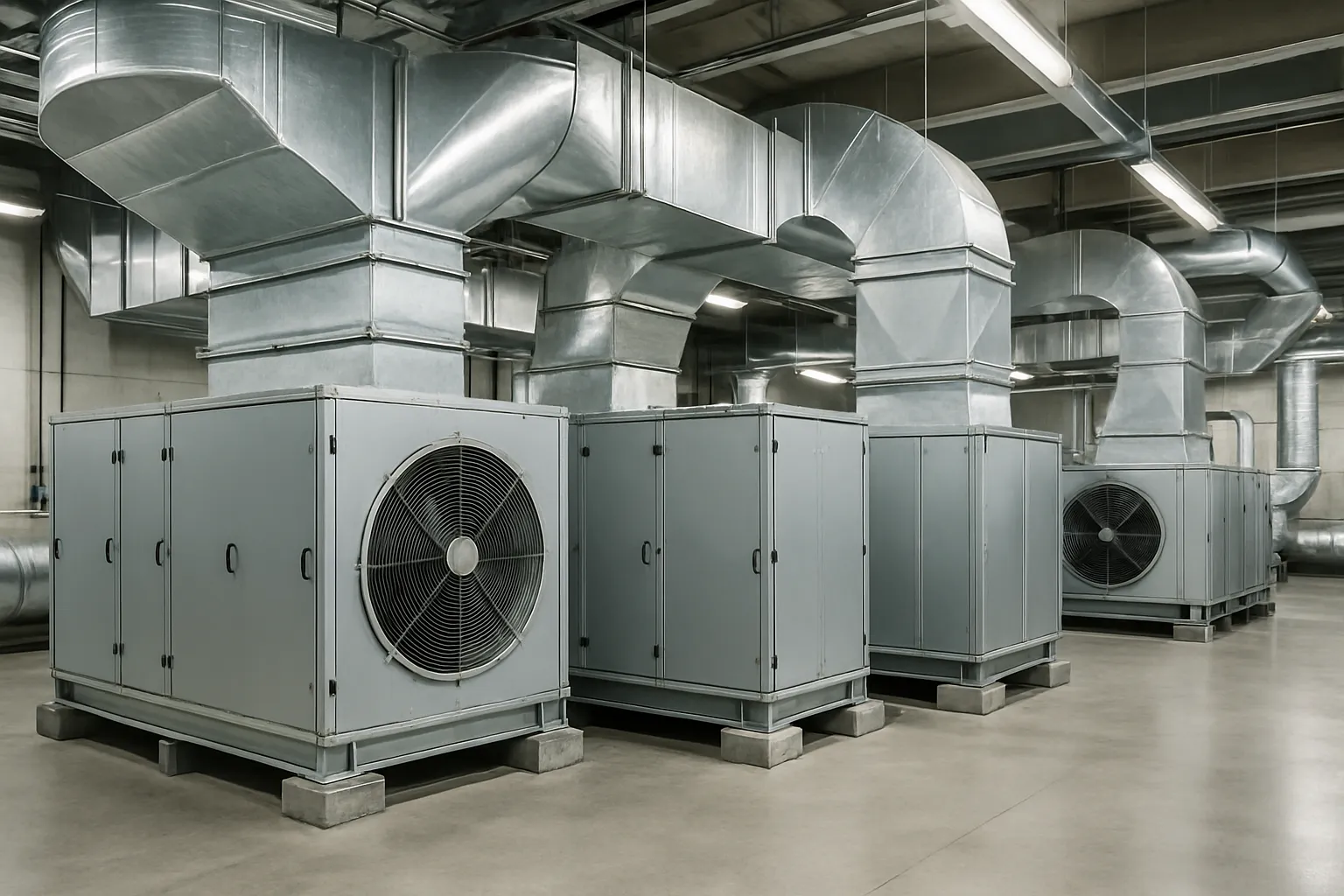
Commercial roofs support significant mechanical loads, including rooftop units (RTUs), air‑cooled chillers, and VRF outdoor units in the 50–500+ ton cooling range for large campuses, distribution centers, and multi‑story offices. Roof replacement must be coordinated to protect these assets and maintain building operations.
Practical coordination steps:
- Inventory rooftop equipment: Document location, weight, curb details, power feeds, and refrigerant piping for RTUs (5–50+ tons each), chillers (100–500+ tons), and VRF condensers before construction.
- Confirm structural load capacity: When adding new insulation or changing roof systems, verify that structural capacity still supports existing mechanical loads and future upgrades.
- Plan temporary shutdowns: Coordinate phasing so HVAC systems serving critical spaces (healthcare, data rooms) have backup or temporary cooling while roof areas beneath equipment are being worked.
- Align penetrations and curbs: Any curb modifications or new penetrations for HVAC should be designed and flashed with the new roof system to maintain warranty and watertightness[6][8].
- Limit future disruption: Where possible, plan future rooftop HVAC upgrades in conjunction with roof replacement to minimize additional penetrations and cranes after the new roof is installed.
Maintenance, Warranty Protection, and ROI After Replacement
Return on investment from commercial roof replacement comes from reduced leak‑related damage, improved energy performance, minimized emergency repairs, and better protection for rooftop mechanical and interior assets. To capture this ROI, property and facility managers need a formal roof management program.
Best‑practice maintenance steps include:
- Scheduled inspections: Many guides recommend bi‑annual or quarterly roof inspections, plus inspections after severe weather, to catch issues early[3][4].
- Prompt repairs: Address minor defects immediately to prevent water intrusion and maintain warranty coverage; delaying repairs can lead to more extensive damage and higher costs[3][4].
- Roof documentation: Maintain records of inspections, repairs, rooftop equipment service, and any modifications or penetrations that could affect performance or warranty[4].
- Drainage and housekeeping: Keep drains, scuppers, and gutters clear; remove debris and manage nearby vegetation to prevent ponding water and premature deterioration[3][4].
Well‑managed roofs can last up to 25 years or more, significantly reducing lifecycle costs and extending the interval before the next major capital project[3][4]. For building owners and managers, the combination of longer service life, fewer emergency calls, and better protection of HVAC assets strengthens the business case for timely, well‑planned commercial roof replacement.
Frequently Asked Questions
What factors most strongly influence commercial roof replacement cost and ROI?
Key cost drivers include roof size, system type (single‑ply, modified bitumen, built‑up), tear‑off requirements, deck repairs, insulation thickness, and regional labor rates[1][2]. ROI is driven by reduced leak‑related damage, fewer emergency repairs, improved energy efficiency from better insulation, and protection of rooftop HVAC and interior assets over a 20–25‑year service life[3][4].
How should property managers evaluate whether to repair or replace a commercial roof?
Managers should compare cumulative repair costs against estimated replacement cost, applying the fifty percent rule as a benchmark[2]. Roof age, leak frequency, and condition of underlying components (insulation, deck, structure) are critical. When leaks are widespread or insulation is saturated, replacement generally offers better long‑term value and risk reduction than ongoing patching[2][3].
How long does a typical commercial roof replacement take for offices or warehouses?
Duration depends on size, material, and weather conditions. Sources report typical timeframes of about 3–7 days for smaller buildings and 1–3 weeks or more for larger or complex roofs[1][2]. Planning work in favorable seasons and coordinating access and phasing with tenants and HVAC contractors helps avoid delays and operational disruptions[2][7][8].
What should facility managers include in a roof maintenance program after replacement?
A strong program includes regular inspections (often at least twice per year and after severe weather), prompt repairs of minor defects, cleaning of drains and debris, and detailed documentation of all work and modifications[3][4]. This protects manufacturer warranties, extends roof life, and reduces long‑term capital and operating expenses for commercial properties[4].
How does commercial roof replacement interact with rooftop HVAC upgrades like RTUs, chillers, and VRF?
Roof replacement is an ideal time to coordinate major rooftop HVAC work. Managers can verify structural loads, design new curbs and penetrations compatible with the roof system, and align crane mobilizations and shutdowns. Integrating RTU, chiller, or VRF upgrades with roofing work reduces future disruptions and maintains membrane integrity and warranty coverage[6][8].
Related Reading on My HVAC Tech
- Strong Commercial HVAC Sales: What Facility Managers Should Do Now
- Trenchless Sewer Repair Guide for Commercial Buildings
Find a Qualified Commercial HVAC Contractor
Need help acting on this? Browse vetted commercial HVAC contractors in your area, or explore commercial HVAC services like preventive maintenance, retrofits, and emergency repair. Are you a contractor? List your business on My HVAC Tech to reach property and facility managers actively searching for help.


