

 My HVAC Tech
Commercial Chiller Maintenance Guide for 50–500+ Ton Systems
Quick Answers for Property & Facility Managers
What is included in commercial chiller maintenance for large commercial buildings?
A typical commercial chiller maintenance program includes daily log checks, leak and vibration inspections, coil and tube cleaning, water treatment, refrigerant charge verification, oil analysis, and electrical testing of motors and starters.[1][2][4] For property and facility managers, this translates into lower energy use, fewer emergency calls, and longer equipment life.
How often should commercial chillers (50–500+ tons) be serviced in offices, retail, or healthcare facilities?
Most experts recommend daily operating checks, weekly visual inspections, quarterly professional service, and deep annual maintenance for commercial chillers.[1][2][4][6] For critical facilities like healthcare, many owners add seasonal performance testing and continuous monitoring to prevent unplanned downtime and temperature excursions.
What is the ROI of a proactive commercial chiller maintenance plan?
Chillers are often a plant’s single largest electric load, so maintaining clean tubes, proper water treatment, and correct refrigerant charge can significantly cut energy waste.[2][4][8] While exact savings vary by site, many facilities see measurable reductions in kWh use and costly emergency repairs when they shift to structured preventive and predictive maintenance.[2][4]
Why commercial chiller maintenance is a strategic asset decision
For most mid- to large-size commercial buildings, the chiller plant is the single largest electrical load and a core comfort and process asset.[2] When commercial chiller maintenance is neglected, fouled tubes, scale, low refrigerant charge, or motor issues drive up energy use and increase failure risk.[2][4][8]
For property managers, facility managers, and building owners overseeing 50–500+ ton air-cooled and water-cooled chillers, the stakes are high:
- Energy spend: Chillers run many hours per year; even modest efficiency losses materially increase utility bills.[2][4][8]
- Tenant satisfaction and revenue: Temperature complaints in offices, retail, or healthcare wings directly impact lease renewals and patient or shopper experience.
- Capital life: Well-maintained chillers, rooftop units (RTUs), and VRF systems last longer and delay six- or seven-figure replacements.[4][8]
- Risk and compliance: Poor water treatment raises Legionella risk and corrosion; refrigerant leaks raise environmental and regulatory concerns.[2][4]
The goal of a commercial chiller maintenance program is to manage these risks systematically through structured inspections, cleaning, monitoring, and documentation.[1][2][4][6][7]
Daily, weekly, and monthly checklists for commercial chiller maintenance
Even if contractors perform most technical work, in-house staff should own a basic inspection routine. Sources recommend a daily operating log and regular visual checks to catch small issues early.[1][2][6][7]
Daily checks (operator or onsite staff)
For chillers serving 50–500+ ton loads in offices, hospitals, warehouses, and retail centers, implement a simple daily checklist:[1][2][6][7]
- Record operating data: Log entering/leaving chilled water temperatures, condenser water temperatures (water-cooled), refrigerant pressures, and key alarms in a central log or CMMS.[2][6][7]
- Check for alarms and fault codes: Review the control panel for fault codes and unusual trends; escalate immediately to your service provider for investigation.[1][3][4]
- Inspect for leaks and abnormal noise: Walk around the chiller for water, oil, or refrigerant indications and listen for unusual sounds or vibration that can signal failing bearings or loose components.[1][3][6][7]
- Clear debris (air-cooled units): Remove leaves, trash, and insulation from around air-cooled chillers and rooftop units to ensure free airflow.[1][3][4]
Weekly to monthly checks
On a weekly or monthly basis, depending on run hours and criticality, most guides recommend:[1][2][4][6][7]
- Internal inspection and tightening: Inspect internal sections of air-cooled units for debris; tighten accessible fasteners and check fan guards and panel screws.[1]
- Visual inspection of piping: Check chilled and condenser water piping, valves, strainers, and insulation for leaks, condensation, and corrosion.[1][2][4][6]
- Filter checks (associated AHUs/RTUs): Verify air filters in air handlers and rooftop units serving the chiller loops are maintained so coil fouling is minimized.
- Quick performance review: Compare current log data to baseline performance (kW/ton, temperatures, delta-T) and flag anomalies in your CMMS or contractor portal.[2][4][7]
Quarterly and annual maintenance tasks for 50–500+ ton chillers
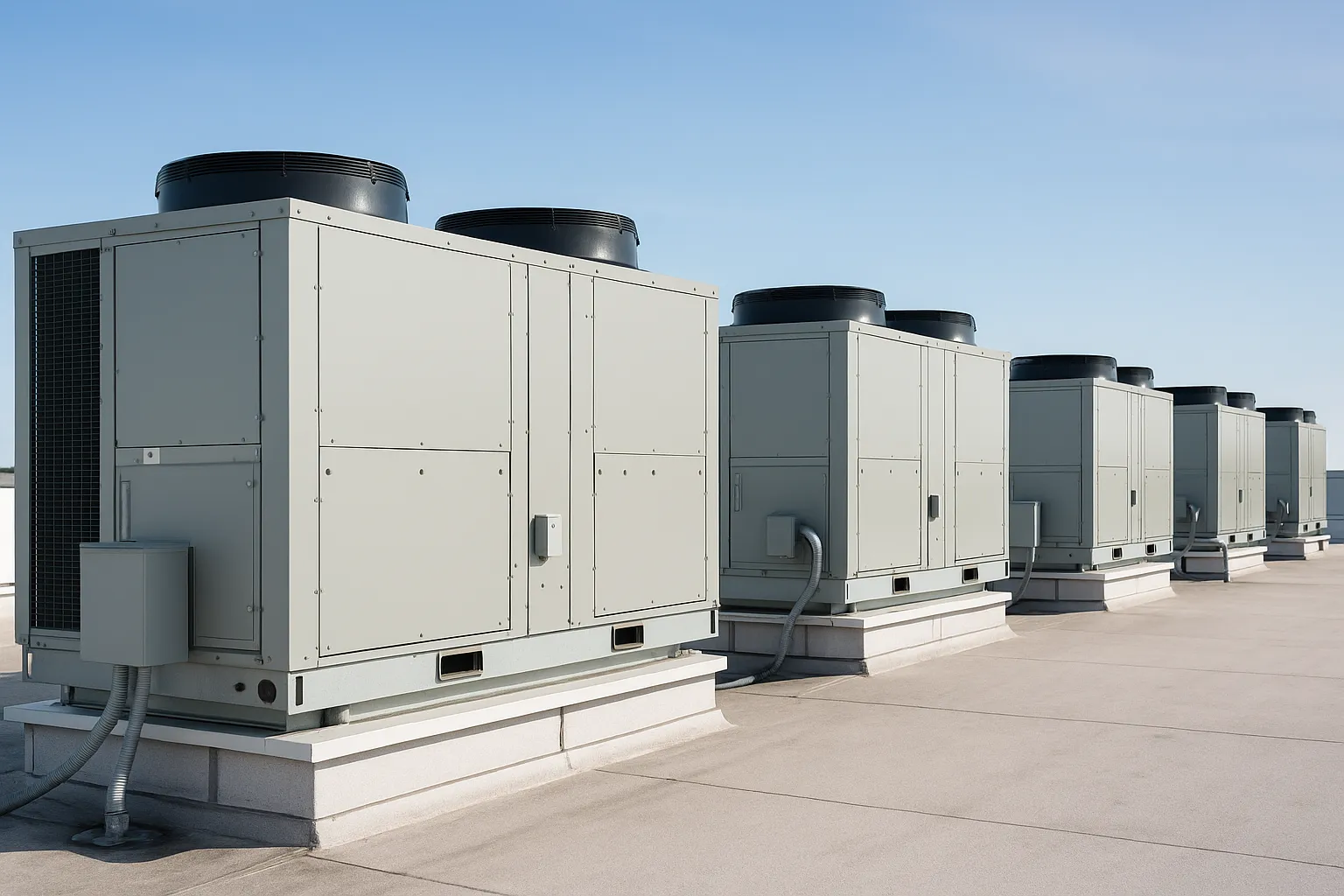
Deeper commercial chiller maintenance should be scheduled quarterly and annually, performed by qualified HVAC technicians. Industry checklists emphasize cleaning, water treatment, refrigerant and oil management, and electrical inspections.[1][2][4][5][6][7]
Quarterly professional service tasks
- Compressor and evaporator tune-ups: Technicians verify suction/discharge pressures and temperatures, oil pressure and levels, and evaporator inlet/outlet conditions to confirm efficient heat transfer.[1][2][4]
- Condenser performance: For air-cooled chillers, technicians inspect and clean condenser coils and check fan motors, currents, and vibration.[1][2][3][4] For water-cooled units, they inspect water quality and tower operation.[2][4][8]
- Refrigerant charge and leak testing: Proper charge is critical to efficiency and capacity; leak testing protects the environment and prevents performance loss.[2][3][4][7]
- Electrical and controls: Technicians inspect starters, contactors, motor windings, safety and sensor calibrations, and microprocessor controls per manufacturer guidance.[2][3]
- Glycol and water treatment review (where applicable): For systems using glycol, contractors verify concentration to prevent freezing and corrosion.[1][4] They also coordinate with your water treatment vendor on dosing and tower chemistry.[2][4][8]
Annual deep maintenance
- Tube and coil cleaning: Fouled condenser and evaporator tubes reduce heat transfer and can significantly reduce chiller efficiency.[2][4][8] Annual mechanical tube brushing (for water-cooled chillers) and deep cleaning of coils in air-cooled units are widely recommended.[2][4]
- Water treatment audits: Review scale, corrosion, and biological control strategies for condenser and chilled water loops; adjust treatment based on lab results and inspection findings.[2][4][8]
- Oil analysis and service: Annual spectrometric oil analysis can detect moisture, acids, and contaminants in compressor oil; oil and filters are changed only when lab results indicate the need.[2][5]
- Safety and redundancy testing: Test safeties (flow switches, freeze protection, high/low pressure cutouts) and verify redundant pumps and backup chillers or RTUs operate correctly before peak season.
Key maintenance priorities by system type and tonnage
Commercial buildings often combine chillers with rooftop units and VRF systems. Priorities differ slightly by configuration, but structured commercial chiller maintenance benefits all.
50–150 ton: small to mid-size buildings and zones
These chillers commonly serve standalone office buildings, data rooms, or smaller retail/medical suites:
- Focus on airflow and water quality: Keep air-cooled coils clean and ensure water treatment is in place even on smaller water-cooled systems.[2][4][8]
- Integrate RTUs and VRF: Coordinate setpoints and schedules so RTUs and VRF units are not “fighting” the chiller plant.
- Simple monitoring: Use basic metering and logging (kWh, temperatures) to track trends in performance.[2][4]
150–500+ ton: campuses, hospitals, large offices and retail
Larger plants often have multiple chillers, cooling towers, primary/secondary pumping, and BMS integration. Maintenance priorities include:
- Full water treatment program: Professional condenser and chilled water treatment is essential to prevent scale, corrosion, and biological growth.[2][4][8]
- Optimized flow and temperatures: Maintain chilled water flow in the manufacturer’s recommended range and keep condenser water conditions within design limits to avoid efficiency losses.[2]
- Sequencing and controls: Regularly review chiller staging logic, setpoints, and schedules in the BMS so equipment runs in its most efficient operating range.
- Predictive maintenance: Sensors and analytics can track fan performance, water usage, temperatures, and refrigerant levels to anticipate failures and schedule maintenance before outages.[4][7]
Water treatment, refrigerant, and oil: non-negotiables for reliability
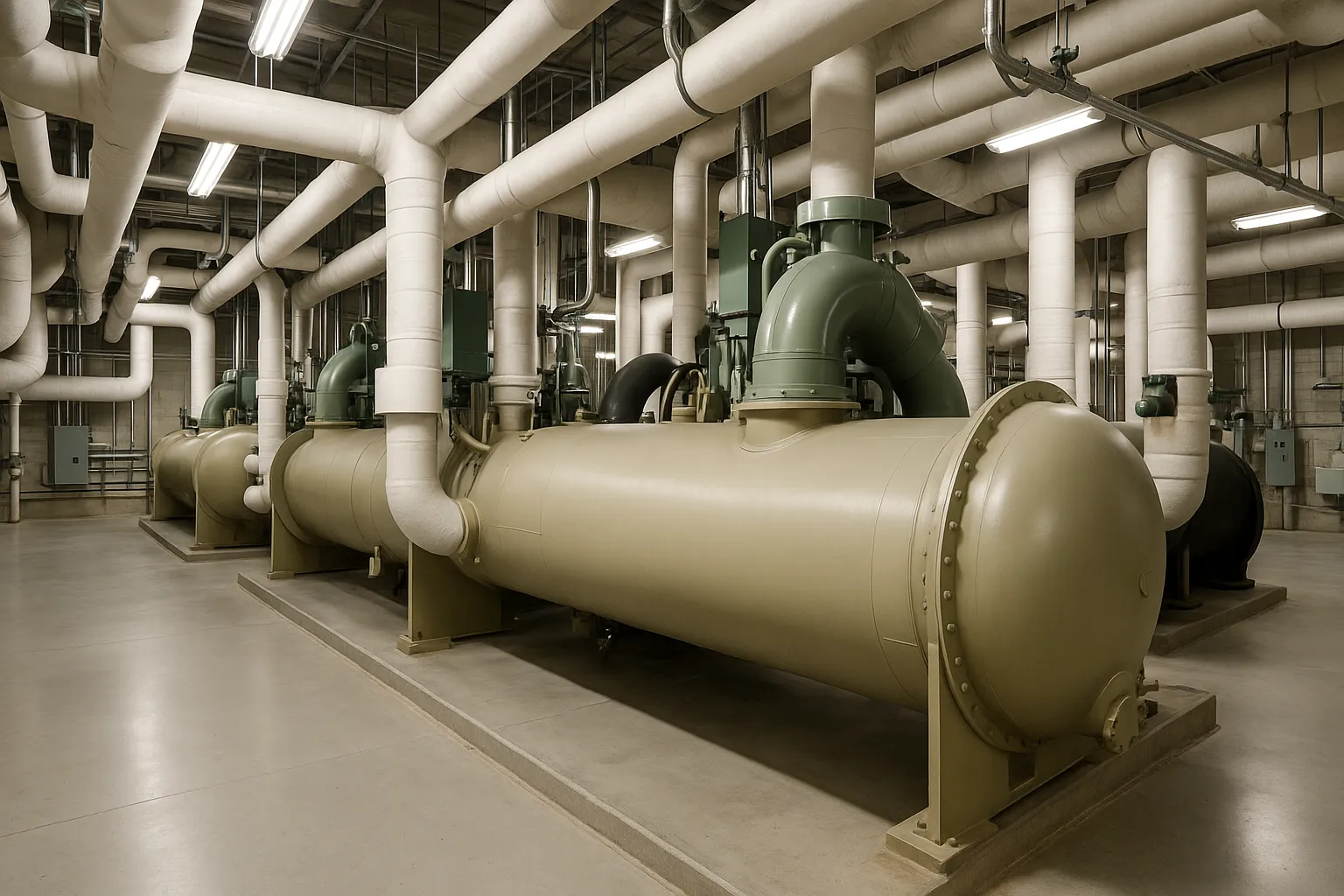
Three areas account for a large portion of commercial chiller maintenance ROI: water treatment, refrigerant management, and oil analysis.[2][4]
Water treatment and tube cleanliness
Water-cooled chillers require proper water treatment and regular tube cleaning to maintain heat transfer.[2][4][8] Poor treatment causes scale and corrosion, leading to higher approach temperatures, higher lift, and increased compressor energy. Annual condenser tube cleaning is widely recommended, with more frequent cleaning in harsh water conditions.[2][4]
Refrigerant charge and leak control
Maintaining the correct refrigerant charge protects capacity and efficiency and reduces environmental impact.[2][3][4] Routine leak testing and prompt repair of leaks in joints, fittings, coils, or tubes are critical.[3][4] Undercharged systems often show higher energy use and cannot maintain design temperatures.
Oil analysis and compressor health
Annual laboratory oil analysis identifies issues such as moisture ingress, acid formation, or metal wear, which can indicate developing mechanical problems in compressors.[2][5] Adjusting maintenance and repairs based on these results supports longer compressor life and fewer catastrophic failures.
Cost, ROI, and how to structure your chiller maintenance program
Exact costs and savings depend on tonnage, run hours, building type, and local utility rates. However, several patterns from industry guidance are useful when building a business case for commercial chiller maintenance.[2][4][8]
- Energy savings potential: Clean heat transfer surfaces, proper water treatment, and correct refrigerant charge all improve efficiency.[2][4][8] For example, maintaining optimal refrigerant charge and controls can reduce cooling energy use compared to neglected systems.[4]
- Avoided emergency repairs: Structured maintenance (logs, inspections, testing, cleaning) reduces the likelihood of major failures that require overtime labor, rental chillers, or temporary cooling solutions.[2][5][7]
- Asset life extension: Regular tube cleaning, water treatment, and oil management slow corrosion and mechanical wear, extending the useful life of chillers, cooling towers, pumps, and associated RTUs and VRF equipment.[2][4][5][8]
- Occupant and process risk reduction: For healthcare, data centers, and food retail, avoiding even short outages is mission-critical. Predictive monitoring and proactive service can significantly reduce unplanned downtime risk.[4][7]
From a program design perspective, property and facility managers should:
- Standardize checklists and logs: Use a centralized digital checklist or CMMS based on recognized chiller maintenance templates to ensure consistency across sites.[6][7][8]
- Define inspection frequencies by criticality: Critical sites (e.g., hospitals) may warrant more frequent inspections and monitoring than standard office buildings.
- Align contracts with performance goals: Work with service providers to structure maintenance agreements around uptime, response times, and energy performance, not just task lists.
- Capture data for continuous improvement: Track kW/ton, approach temperatures, alarms, and failures by asset to inform future capital planning and optimization projects.
For managers overseeing portfolios of commercial buildings, robust commercial chiller maintenance is less an expense and more an ongoing risk management and performance improvement strategy.
Frequently Asked Questions
How should I budget for commercial chiller maintenance on a multi-tenant office or retail property?
Budgeting should include routine inspections, quarterly service, annual tube or coil cleaning, and professional water treatment for water-cooled systems.[1][2][4][8] While costs vary by site and tonnage, these expenses are typically offset by lower energy use, fewer emergency calls, and extended asset life, improving NOI and long-term capital planning.
What are the main risks of deferring commercial chiller maintenance in healthcare or critical facilities?
Deferring maintenance increases the likelihood of sudden failures, unstable temperatures, and moisture issues that can disrupt clinical operations or sensitive processes.[2][4][5][8] It also accelerates tube fouling and corrosion, driving up energy consumption and shortening asset life, often resulting in unplanned capital expenditures and operational risk.
How does commercial chiller maintenance interact with rooftop units and VRF systems in mixed-technology buildings?
In mixed systems, chillers, RTUs, and VRF must be coordinated through controls and setpoints to avoid simultaneous heating and cooling or over-ventilation.[4][8] Good maintenance ensures coils are clean, sensors are calibrated, and schedules are aligned, helping property and facility managers minimize energy waste and comfort complaints across zones.
What should property managers look for when selecting a commercial chiller maintenance provider?
Look for experience with your chiller type and tonnage, documented checklists, water treatment expertise, strong safety practices, and the ability to support predictive monitoring and data-driven recommendations.[2][4][6][7] Contracts should clearly define scope, response times, reporting standards, and how performance will be measured over the life of the agreement.
How can digital logs and predictive monitoring improve commercial chiller maintenance outcomes?
Digital logs and sensors allow continuous tracking of temperatures, pressures, flow, fan performance, water usage, and refrigerant levels.[4][7] Analytics can flag deviations from normal operation early, enabling predictive maintenance that reduces catastrophic failures, stabilizes comfort, and supports ongoing energy optimization across commercial portfolios.
Related Reading on My HVAC Tech
- Trane Technologies Acquires LiquidStack to Advance Data Center Liquid Cooling
- ashrae 90.1: What Commercial Property Managers Need to Know
Find a Qualified Commercial HVAC Contractor
Need help acting on this? Browse vetted commercial HVAC contractors in your area, or explore commercial HVAC services like preventive maintenance, retrofits, and emergency repair. Are you a contractor? List your business on My HVAC Tech to reach property and facility managers actively searching for help.


