

 My HVAC Tech
Commercial HVAC Upgrade ROI: A Practical Guide for Property Managers
Quick Answers for Property & Facility Managers
What is a realistic commercial HVAC upgrade ROI for existing office and retail buildings?
For existing commercial buildings, documented HVAC upgrades often reduce HVAC energy use by roughly 15–40% depending on baseline conditions and scope.[2][5] Over a typical 15-year equipment life, that can translate into strong, positive commercial hvac upgrade roi with payback commonly in the 2–7 year range for targeted retrofits.[2][8][10]
How should property managers calculate commercial HVAC upgrade ROI before approving a project?
Most sources recommend combining a simple ROI formula with payback period: annual energy and maintenance savings over total project cost, plus years to recoup the investment.[10][12] For commercial hvac upgrade roi, also account for non-energy benefits like tenant retention, avoided emergency replacements, and compliance upside in your financial model.[7][8]
Which commercial HVAC upgrades typically deliver the fastest ROI in multi-tenant buildings?
Recent industry guidance highlights smart controls, building automation, and variable-speed drives as leading fast-payback measures, often in the 1–4 year range when baselines are inefficient.[1][2][6][8] These upgrades can cut fan, pump, and overall HVAC energy by 15–30% or more, improving comfort with relatively modest capital cost.[1][2][4][14]
Understanding Commercial HVAC Upgrade ROI in Today’s Market
For property managers, facility managers, and building owners, commercial hvac upgrade roi is now a board-level topic. HVAC commonly accounts for 40–60% of total energy use in commercial buildings, so efficiency upgrades can materially shift operating expenses and asset value.[2][7] Recent retrofit guides report HVAC energy reductions of 15–40% in typical commercial projects, with some integrated approaches surpassing 50% savings in best-case scenarios.[1][2][4][9][11]
Case studies of energy-efficiency retrofits in offices, retail, and hotels show average total-building energy reductions in the 15–20% range, with HVAC improvements alone often contributing 10–15% of total energy savings.[5] Other documented pilots and integrated system retrofits demonstrate potential reductions of 28–60% in HVAC energy use with payback periods as short as two years when projects combine smart controls, optimized scheduling, and targeted equipment replacements.[1][9][14]
For decision-makers, the takeaway is clear: a well-designed HVAC upgrade program can deliver a strong, defensible ROI, provided that you carefully scope measures, verify baseline performance, and track actual savings against expectations.
How to Calculate Commercial HVAC Upgrade ROI and Payback
To make commercial hvac upgrade roi actionable, you need a consistent method for evaluating investments. Many industry resources recommend using two metrics side by side: simple ROI and payback period.[10][12]
Step-by-step ROI calculation process
Use these steps before you sign any major HVAC contract:
- Gather baseline data. Collect at least 12 months of utility bills, run-hours, and major repair records for your rooftop units, chillers, boilers, and air handlers. This establishes current energy and maintenance costs.[2][5]
- Estimate annual energy savings. For targeted retrofits (controls, VFDs, tune-ups), documented ranges are commonly 15–30% HVAC energy savings.[1][2][6][14] Comprehensive, integrated retrofits can reach 30–50%+ where baselines are poor.[1][4][9][11] Apply conservative values based on similar building types and climates.
- Estimate maintenance and repair savings. Factor in avoided emergency service calls, reduced downtime, and lower parts replacement for new equipment compared with aging systems.[6][8]
- Calculate annual savings in dollars. Multiply kWh/therm savings by your utility rates and add reduced maintenance costs to arrive at total annual savings.
- Apply a simple payback formula. Industry guidance frequently uses payback (years) = net installed cost ÷ annual savings.[12] This gives a clear, board-friendly indicator of how long the project takes to pay for itself.
- Estimate lifetime ROI. A common formula is ROI = (Annual Savings × Equipment Lifespan – Total Project Cost) ÷ Total Project Cost.[10] For many commercial HVAC projects, reported ROI over the first decade has landed in the 25–50% range or higher for older buildings.[10]
When you present commercial hvac upgrade roi to stakeholders, document your assumptions, cite industry ranges, and distinguish between conservative, expected, and best-case scenarios so the board can weigh risk appropriately.
Priority Upgrades: Rooftop Units, Chillers, and VRF Systems
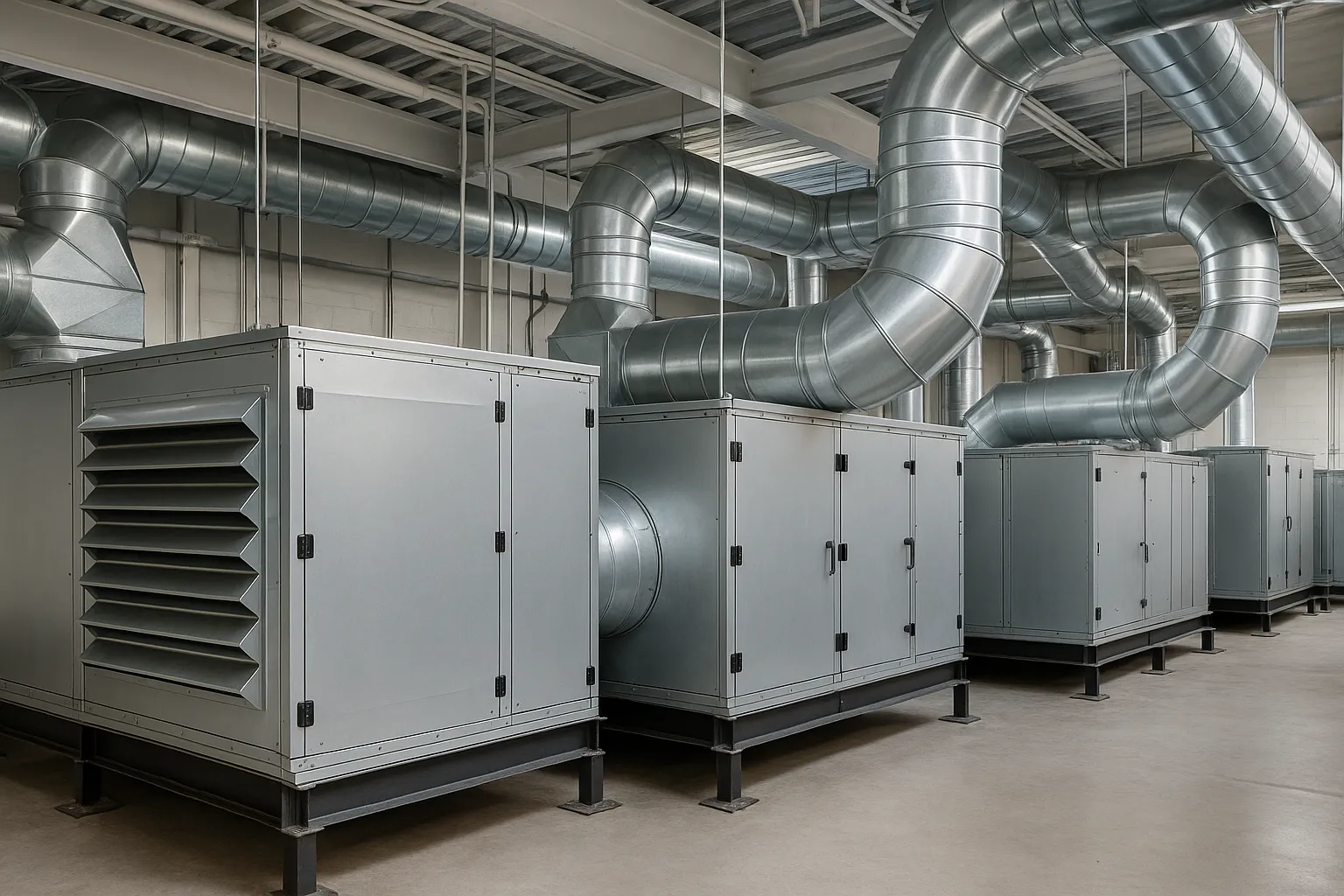
In buildings with 50–500+ tons of cooling capacity, ROI varies by equipment type and condition. The highest-yield upgrades usually target rooftop units (RTUs), central chillers, and increasingly VRF (variable refrigerant flow) systems.
Rooftop units (RTUs) in 50–200 ton ranges
Many offices, retail centers, and medical offices rely on multiple packaged RTUs that together provide 50–200 tons of cooling. Older constant-volume RTUs with outdated controls and low-efficiency compressors are prime candidates for upgrades.[1][2][6]
- Efficiency upgrades. Replacing constant-volume air handling with variable air volume (VAV) designs can cut fan energy 40–60% while improving zone control.[1] Adding variable-speed drives (VFDs) to supply fans and condenser fans further reduces energy use.
- Controls and BAS integration. Modern DDC (direct digital control) or building automation systems with optimized schedules, demand-controlled ventilation, and supply-air temperature reset can reduce total HVAC energy 10–25%.[1]
- RTU replacement strategy. For units beyond 15–20 years, many sources report full replacement projects achieving 15–30% HVAC energy savings with payback in the 4–7 year range, especially when existing equipment is significantly below current efficiency standards.[2][8]
Central chillers in 200–500+ ton plants
Large offices, campuses, hospitals, and mixed-use towers often operate chilled-water plants in the 200–500+ ton range. Here, commercial hvac upgrade roi is driven by both plant efficiency and distribution system improvements.[4][6]
- High-efficiency chiller replacement. Newer chillers offer substantially higher full- and part-load efficiencies than older machines. In retrofit case studies, optimized plants have achieved 50% or greater HVAC energy savings when multiple measures are combined.[4]
- Pumping upgrades. Retrofitting constant-speed pumps with VFDs and advanced differential pressure reset has been shown to reduce pumping energy 50–70%.[1]
- Plant controls and optimization. Upgrading from standalone controls to plant-level optimization (chiller staging, condenser water reset) yields additional efficiency gains and can materially shorten payback periods.[1][4]
VRF systems for multi-tenant and healthcare spaces
VRF systems are increasingly used in offices, healthcare, and mixed-use buildings where zoning and part-load efficiency are critical. Documented retrofits that replace older RTUs or split systems with high-efficiency VRF and right-sized ventilation can deliver 30–50% or more reductions in total energy use in some decarbonization pilots.[9]
- Zoning and comfort. VRF provides individualized zone control, improving tenant satisfaction and potentially reducing turnover risk—a non-energy component of commercial hvac upgrade roi.[8][9]
- Integration with ERV/HRV. Pairing VRF with high-efficiency energy recovery ventilators (ERV/HRV) and smart ventilation control has yielded total building energy reductions exceeding 50% in documented pilots.[9]
- Best-fit tonnage ranges. VRF is often applied in 30–200+ ton aggregated capacity for floors or wings rather than entire mega-plants, making it suitable for phased, tenant-level upgrades.
Practical Action Plan: From Audit to Verified Savings
To turn potential ROI into actual results, property and facility managers should follow a disciplined, stepwise process.
Step 1: Commission a detailed energy and HVAC audit
Several national programs emphasize the value of a formal Level 2 energy audit and building simulation before major retrofit decisions.[13] This typically includes site inspections, logging of run-hours, performance testing for RTUs and chillers, and identification of operational issues (schedules, setpoints, simultaneous heating/cooling).
- Scope audits across all major equipment: rooftop units, chillers, boilers, pumps, fans, and controls.
- Document current tonnage (e.g., 50, 150, 300, 500+ tons) and load profiles by building type (office, retail, healthcare, warehouse).
- Request specific savings estimates and cost ranges for each recommended measure.
Step 2: Prioritize no-/low-cost measures
Case studies show that operational fixes—coil cleaning, schedule corrections, setpoint optimization, and simple control repairs—can deliver 5–10% energy savings with minimal capital outlay.[2] Implement these first to capture early wins and build a track record of savings.
Step 3: Target mid-capital retrofits with strong payback
Mid-range measures like VFD retrofits, economizer repair, and control recommissioning typically achieve 15–20% HVAC energy savings when applied to buildings with outdated systems.[2] Many sources cite payback periods of 2–4 years for these upgrades, making them attractive for annual budgeting cycles.[2][6][8]
- Install VFDs on large supply fans, cooling tower fans, and secondary pumps.
- Repair or add economizers on RTUs serving offices and retail where outside air conditions allow free cooling.
- Upgrade pneumatic or legacy electronic controls to modern DDC platforms with advanced sequences.[1]
Step 4: Plan major equipment replacements strategically
Full equipment replacements—new chillers, high-efficiency RTUs, or VRF conversions—typically involve higher capital cost but can still deliver compelling commercial hvac upgrade roi when existing equipment is 20+ years old or frequently failing.[2][6][8]
- Prioritize systems with recurring repair costs, comfort complaints, or non-compliance with current efficiency or refrigerant regulations.[7][8]
- Bundle projects to capture utility incentives or tax benefits when available, improving net ROI.
- Use building modeling to compare scenarios: like-for-like replacement vs. high-efficiency systems vs. integrated solutions.
Step 5: Verify and document savings
High-performing organizations treat HVAC upgrade ROI as a measurable outcome, not a marketing claim.
- Track post-retrofit energy data for at least 12 months, normalized for weather and occupancy.[5][13]
- Compare actual savings to audit predictions; adjust control strategies where gaps appear.
- Document tenant comfort improvements and reductions in complaints as part of your non-energy ROI story.[8]
Non-Energy Returns: Compliance, Risk Reduction, and Asset Value
While energy savings drive most commercial hvac upgrade roi calculations, property managers should also weigh strategic benefits that are harder to quantify but heavily influence asset performance.
- Regulatory and ESG compliance. National studies emphasize that retrofitting existing HVAC systems is a major lever for meeting energy code, decarbonization, and corporate ESG commitments.[7][9][11] Avoiding fines or penalties and supporting disclosures adds downstream value.
- Risk mitigation. Proactive upgrades reduce the likelihood of catastrophic failures, emergency replacements, and business interruption, especially in healthcare and mission-critical facilities.[6][8]
- Tenant satisfaction and retention. Improved comfort, air quality, and reliability help stabilize occupancy rates. While difficult to express in a single ROI figure, these outcomes tie directly to net operating income and property valuation.
- Marketability and valuation. Documented energy performance, modern HVAC systems, and automation can enhance capitalization rates and investor appeal in commercial real estate markets.[15]
When framing HVAC investments for owners or boards, present commercial hvac upgrade roi as a composite of energy, maintenance, risk, ESG, and tenant outcomes rather than a narrow utility-only metric.
Building-Type Considerations: Offices, Retail, Healthcare, and Warehouses
The right upgrade mix depends on your building profile and occupancy patterns.
- Office buildings (50–300 tons). Often benefit most from controls upgrades, VFDs, and RTU replacements. Documented retrofits show office energy reductions in the 15%+ range when HVAC measures are prioritized.[5][14]
- Retail centers. High internal loads and variable occupancy make demand-controlled ventilation, economizers, and high-efficiency RTUs particularly valuable. Retail case studies report 17%+ average energy reductions.[5]
- Healthcare facilities. Central plants and critical ventilation requirements favor chiller plant optimization, ERVs, and high-efficiency heat recovery. Integrated retrofits have delivered 50% or more HVAC energy savings in some pilots.[4][9]
- Warehouses and logistics. Often require targeted ventilation and limited cooling tonnage. Here, smart controls, destratification, and right-sized systems can generate attractive ROI with relatively modest capital.
Aligning upgrade strategies with building type and tonnage range ensures commercial hvac upgrade roi is not just theoretical but realized in day-to-day operations and financial performance.
Frequently Asked Questions
How much should a commercial HVAC upgrade cost, and what ROI is realistic for a 200–500 ton building?
Total project costs vary widely by scope, but sources consistently report that well-designed retrofits in 200–500 ton plants can reduce HVAC energy use 15–40% or more.[1][2][4] When translated over a typical 15-year life, many projects achieve positive ROI within 4–7 years, with integrated solutions occasionally reaching shorter paybacks.[6][8][10]
What compliance or ESG factors should facility managers consider when planning HVAC upgrades?
National analyses emphasize that existing-building HVAC retrofits are a major lever for meeting energy codes, decarbonization, and corporate ESG goals.[7][9][11] Upgrades supporting high-efficiency equipment, optimized ventilation, and integrated control strategies help reduce emissions, support disclosure requirements, and lower long-term regulatory and reputational risk for owners.
What are the biggest risks that can erode commercial HVAC upgrade ROI?
Key risks include inaccurate baseline data, overestimated savings, poor commissioning, and lack of ongoing performance tracking. Studies stress the importance of detailed audits, building simulation, and commissioning to avoid shortfalls.[1][2][13] Failing to maintain new equipment and controls can also erode savings over time, undermining expected ROI.[6][14]
How should property managers compare different HVAC upgrade options when budgets are limited?
Guidance for commercial hvac upgrade roi recommends comparing options on payback, total cost of ownership, and non-energy benefits.[8][12] Start with low-/mid-capital measures like controls and VFDs, which often deliver 2–4 year paybacks, then phase in larger equipment replacements once documented savings establish confidence and justify higher capital allocations.[2][6][8]
Do smart controls and building automation reliably deliver ROI in existing commercial buildings?
Documented case studies show smart controls, optimized schedules, and advanced automation commonly provide 10–25% HVAC energy savings, sometimes more when baselines are inefficient.[1][2][14] Many sources cite payback periods of 1–4 years for these measures, making them among the most reliable starting points for commercial hvac upgrade roi in offices and retail buildings.[8][14]
Can HVAC retrofits compete with solar or other onsite generation in terms of ROI for owners?
Research comparing commercial retrofits indicates that year-one savings from HVAC projects can be comparable to solar, and HVAC measures have been widely adopted due to strong economics and operational benefits.[15] Because HVAC often represents 40–60% of building energy use, targeted upgrades provide a powerful, sometimes faster, path to cost and emissions reductions.[2][7][15]
Related Reading on My HVAC Tech
- New HVAC Supplier Price Increases Reach 15% in September 2026
- Office Building HVAC Systems: Practical Guide for Property & Facility Managers
Find a Qualified Commercial HVAC Contractor
Need help acting on this? Browse vetted commercial HVAC contractors in your area, or explore commercial HVAC services like preventive maintenance, retrofits, and emergency repair. Are you a contractor? List your business on My HVAC Tech to reach property and facility managers actively searching for help.


