

 My HVAC Tech
Commercial HVAC Inspection Frequency: A Practical Guide for Building Owners
Quick Answers for Property & Facility Managers
How often should commercial HVAC systems be inspected?
Commercial HVAC systems should receive routine inspections at least quarterly, with monthly operational checks and detailed preventive maintenance at least twice yearly. Exact commercial HVAC inspection frequency depends on equipment type, operating hours, indoor-air-quality requirements, manufacturer instructions, climate, and building risk. Large or mission-critical systems may require monthly or continuous monitoring.
What is included in a commercial HVAC inspection?
A commercial HVAC inspection reviews filters, coils, fans, belts, motors, electrical connections, controls, refrigerant indicators, condensate systems, airflow, water flow, safety devices, and operating temperatures. Chillers also require water chemistry and tube or heat-exchanger review; VRF systems require branch controls, piping, communication, and indoor-unit checks.
Does HVAC inspection frequency change for healthcare and other critical buildings?
Yes. Healthcare, laboratories, data centers, senior-living facilities, and buildings with strict humidity or ventilation requirements generally need more frequent inspections than ordinary offices or retail properties. Use the equipment manufacturer’s schedule, the building’s risk assessment, applicable codes, and ASHRAE Standard 180 as the planning baseline.
Commercial HVAC Inspection Frequency: Start With a Risk-Based Schedule
There is no single inspection interval for every commercial building. The appropriate commercial hvac inspection frequency combines the manufacturer’s instructions, ASHRAE guidance, local requirements, equipment condition, operating hours, occupancy, and the consequences of failure. ASHRAE Standard 180 establishes minimum inspection and maintenance practices for commercial HVAC systems, with frequencies based on time, runtime, or system condition.
For most offices, retail locations, warehouses, and similar properties, use monthly operating checks, quarterly documented inspections, and seasonal preventive maintenance before major heating and cooling periods. Healthcare, data centers, laboratories, and other critical facilities may need monthly technician visits, continuous controls monitoring, redundancy testing, and documented testing of ventilation and humidity performance.
- Monthly: Review alarms, temperatures, schedules, filter condition, unusual noise, leaks, and tenant comfort complaints.
- Quarterly: Inspect accessible mechanical, electrical, airside, refrigeration, drainage, and control components.
- Semiannually: Perform detailed heating- and cooling-season preventive maintenance, including cleaning, testing, and adjustments.
- Annually: Complete a documented performance review, refrigerant records review, control calibration as needed, and capital-planning assessment.
Commercial HVAC Inspection Frequency by Equipment Type and Tonnage
Equipment size alone does not determine frequency, but a 500-ton central plant has greater operational and financial exposure than a small package unit. A property manager should classify equipment by capacity, redundancy, age, runtime, and building consequence rather than relying only on a calendar.
- Rooftop units, approximately 50 to 150 tons: Inspect filters, economizers, dampers, coils, belts, bearings, motors, burners or electric heat, condensate drains, refrigerant circuit indicators, safeties, and controls at least quarterly. Inspect more often in dusty warehouses, restaurants, retail buildings with long operating hours, or locations exposed to salt or heavy pollen.
- Large rooftop systems, approximately 150 to 500+ tons: Use monthly operating reviews and quarterly technician inspections, with semiannual detailed service. Trend supply-air temperature, static pressure, compressor or refrigerant performance, fan operation, and economizer position through the building automation system when available.
- Air-cooled chillers, approximately 50 to 500+ tons: Inspect monthly during the operating season and complete detailed seasonal service. Review refrigerant and oil indicators, condenser coils, fans, compressors, flow switches, pumps, strainers, controls, vibration, and leaving-water temperature.
- Water-cooled chillers, approximately 150 to 500+ tons: Inspect plant operation at least monthly and review water treatment, condenser-water flow, cooling-tower condition, approach temperatures, tubes, pumps, valves, and controls. Schedule tube cleaning and specialized testing according to fouling, water chemistry, operating data, and manufacturer requirements.
- VRF systems: Inspect indoor units, filters, drain pans, pumps, outdoor coils, fans, refrigerant piping, insulation, branch selector boxes, addressing, communication faults, and controller operation at least twice yearly. High-occupancy offices, hotels, and healthcare facilities may justify quarterly checks.
Step-by-Step Commercial HVAC Inspection Process for Facility Managers
A repeatable process produces better records and more useful contractor proposals than a basic “unit checked” notation. Require the service provider to identify asset numbers, measured conditions, deficiencies, urgency, and recommended corrective action.
- Build an asset register listing equipment type, manufacturer, model, serial number, capacity, refrigerant, location, controls connection, installation date, and criticality.
- Review operating history before the visit, including alarms, comfort complaints, utility trends, work orders, filter changes, refrigerant additions, and previous deficiencies.
- Perform a visual and safety review. Check access, guards, electrical panels, disconnects, corrosion, water or oil marks, unusual vibration, combustion concerns, and hazardous conditions.
- Inspect airside components, including filters, coils, fans, belts, dampers, economizers, insulation, duct connections, condensate pans, drains, and outdoor-air paths.
- Test operating performance. Record supply and return temperatures, static pressure, airflow or water-flow indicators, voltage, amperage, control response, and relevant pressure or temperature readings.
- Review refrigeration components without releasing refrigerant. Look for oil staining, abnormal superheat or subcooling where appropriate, compressor condition, coil condition, leak indicators, and documented refrigerant additions.
- For chillers, document chilled-water and condenser-water temperatures, flow, approach, pump operation, water chemistry results, tower condition, tube-cleaning needs, and alarm history.
- For VRF, test communication and controller status, inspect branch components and piping insulation, verify drain operation, and review indoor-unit performance by zone.
- Classify findings as immediate safety or shutdown risk, urgent repair, planned repair, or monitor. Include photographs and budgetary scope.
- Update the maintenance plan and schedule repairs based on risk, season, parts lead time, tenant impact, and available redundancy.
Commercial HVAC Inspection Checklist by Visit Frequency
Use the following checklist as a management framework, then adapt it to the equipment manufacturer and local requirements.
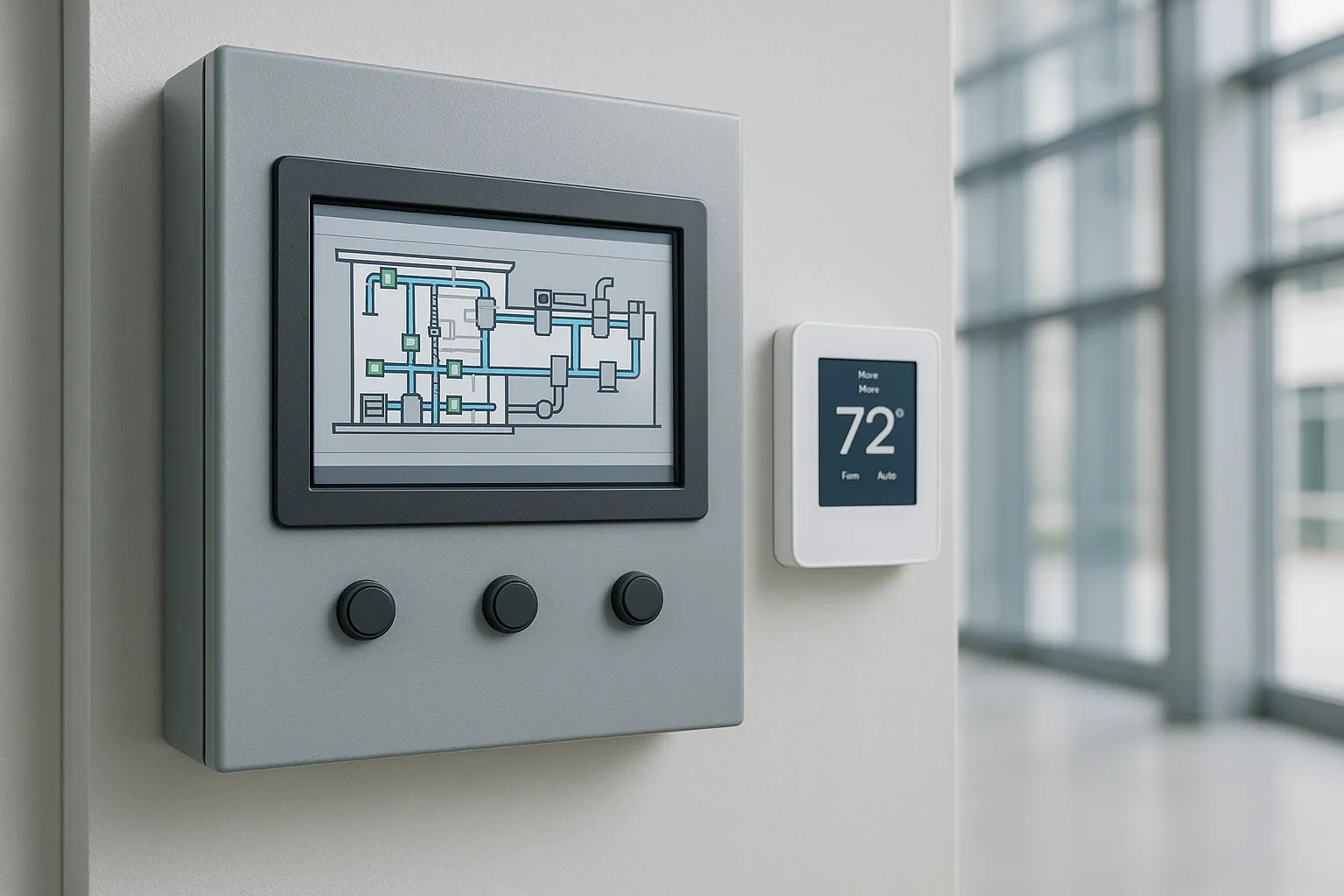
- Monthly building review: Check BAS alarms, occupied schedules, setpoints, tenant complaints, abnormal noise, leaks, filter loading, and visible rooftop or mechanical-room conditions.
- Quarterly inspection: Inspect filters, coils, fans, belts, bearings, dampers, economizers, condensate systems, electrical connections, safeties, controls, refrigerant indicators, and insulation.
- Cooling-season service: Clean coils, verify airflow, test economizer operation, confirm drain capacity, review condenser performance, and document compressor or chiller operating data.
- Heating-season service: Inspect burners or electric heat, combustion safety where applicable, heat exchangers, ignition, flame safeguards, belts, filters, and heating controls.
- Chiller plant checklist: Review pumps, strainers, water chemistry, cooling towers, condenser-water flow, tube fouling indicators, vibration, sequencing, and plant safeties.
- VRF checklist: Check indoor-unit filters and drains, outdoor coils and fans, branch selector components, refrigerant piping insulation, communication errors, zone temperatures, and controller settings.
Refrigerant Compliance and Inspection Records
Federal refrigerant requirements can affect inspection planning. Under EPA Section 608 requirements, comfort-cooling appliances containing 50 or more pounds of refrigerant may require annual leak inspections when the applicable leak-rate trigger has been exceeded; commercial refrigeration equipment has different thresholds and frequencies. Requirements vary by equipment category, refrigerant, and regulatory status.
Property managers should ask for the appliance full-charge quantity, equipment category, leak-rate calculations where applicable, inspection date, inspection method, accessible components examined, leak locations, repairs, and verification-test documentation. Leak inspections must be performed and documented by appropriately certified personnel when required. Also check state and local rules, which may be more restrictive.
Cost, Budgeting, and ROI for Commercial HVAC Inspections
Inspection pricing is not a universal per-ton number. Cost depends on equipment count, access, location, controls integration, refrigerant circuit complexity, water treatment, required measurements, after-hours work, and whether the visit includes cleaning or repairs. A 50-ton rooftop inspection and a 500+ ton chiller-plant assessment should not be compared as equivalent services.
Request proposals that separate inspection labor, testing, cleaning, consumables, corrective repairs, emergency response, controls trending, and capital recommendations. Compare the cost with avoided downtime, emergency labor, spoiled inventory, tenant disruption, comfort complaints, premature replacement, and energy waste. The U.S. Department of Energy states that preventive maintenance is a low-cost practice that can reduce energy waste and extend equipment life; its operations-and-maintenance guidance estimates potential energy savings of 5% to 20% from best practices, but actual results depend on building condition and implementation.
Track ROI using documented baselines: utility consumption normalized for weather and occupancy, comfort complaints, emergency calls, refrigerant additions, downtime, repair spending, and equipment availability. Do not claim savings from an inspection alone. Attribute savings only after verifying that identified repairs, scheduling changes, cleaning, controls work, or other measures were completed and measured.
How to Select a Commercial HVAC Inspection Provider
For property managers, the best provider is not necessarily the lowest bidder. Require commercial experience with the specific equipment and building type, clear technician qualifications, calibrated test instruments, insurance, safety procedures, emergency support, and a sample report.
- Ask whether the contractor has experience with rooftop units, 50- to 500+ ton chillers, VRF systems, BAS controls, and your refrigerant types.
- Require measured data rather than pass/fail language alone.
- Confirm the scope includes equipment identification, photographs, deficiencies, risk ranking, and repair recommendations.
- Require Section 608 certification when regulated refrigerant work is involved.
- Specify response times, documentation ownership, warranty terms, and approval limits in the service agreement.
- Use inspection findings to create a 12-month maintenance calendar and a three- to five-year capital forecast.
For most commercial properties, a practical starting point is monthly operational review, quarterly documented inspection, and semiannual detailed preventive maintenance. Adjust that baseline for equipment size, runtime, occupancy risk, climate, manufacturer instructions, ASHRAE Standard 180, EPA requirements, and the consequences of failure.
Frequently Asked Questions
What is the recommended commercial HVAC inspection frequency for an office building?
For a typical office building, schedule monthly operating and alarm reviews, quarterly documented inspections, and detailed preventive maintenance before the cooling and heating seasons. Rooftop units should receive filter, coil, drain, fan, belt, control, and safety checks. Larger systems, long operating hours, poor outdoor-air quality, or repeated comfort complaints justify more frequent inspections.
How often should a commercial rooftop HVAC unit be serviced?
Most commercial rooftop units should receive quarterly inspections and at least two detailed preventive-maintenance visits annually. Monthly visual or controls reviews are valuable for units serving high-occupancy offices, retail, healthcare, restaurants, and warehouses. The final interval should follow the manufacturer’s requirements and account for dust, corrosion, runtime, filter loading, and equipment age.
How often do commercial chillers need inspection?
Inspect chiller operation monthly during the operating season and perform detailed service at least semiannually, with additional work based on runtime, water chemistry, fouling, vibration, and manufacturer guidance. Water-cooled plants require attention to cooling towers, pumps, flow, condenser-water treatment, and tubes. Trend data can identify degradation before a capacity or efficiency problem becomes an outage.
How often should a commercial VRF system be inspected?
Commercial VRF systems generally benefit from inspections at least twice per year, with quarterly service for critical or heavily occupied facilities. Review indoor-unit filters and drains, outdoor coils and fans, piping insulation, branch selector components, communication faults, controllers, and zone temperatures. Any refrigerant or leak-repair work should be performed by appropriately qualified personnel.
What does a commercial HVAC inspection cost?
There is no reliable universal price because scope varies by equipment count, tonnage, access, controls, testing, cleaning, refrigerant requirements, and location. Request an itemized proposal separating inspection, preventive maintenance, repairs, consumables, and emergency coverage. Evaluate ROI against avoided downtime, emergency repairs, tenant disruption, energy waste, and premature equipment replacement rather than comparing price alone.
What records should a commercial HVAC owner retain after an inspection?
Retain asset details, service dates, technician and certification information, measured readings, photographs, alarms, deficiencies, repair approvals, invoices, refrigerant additions, leak-inspection documentation, verification tests, water-treatment results, and updated maintenance schedules. Consistent records help demonstrate due diligence, support warranty claims, improve contractor bidding, and inform replacement decisions for aging 50- to 500+ ton equipment.
Related Reading on My HVAC Tech
- Trane Raises Outlook as Commercial HVAC Orders Surge
- Commercial HVAC Upgrade ROI: A Practical Guide for Property Managers
Find a Qualified Commercial HVAC Contractor
Need help acting on this? Browse vetted commercial HVAC contractors in your area, or explore commercial HVAC services like preventive maintenance, retrofits, and emergency repair. Are you a contractor? List your business on My HVAC Tech to reach property and facility managers actively searching for help.


